Context
Today marked the completion of the Home_Edit item placement system. After several days of iteration, refactoring, and bug fixing, the goal was to fully stabilize placement across all interior surfaces and ensure everything persisted correctly between sessions.
Final Placement Fixes
Most of today’s work focused on resolving remaining issues with wall and ceiling placement. These were the most error‑prone cases due to camera orientation, coordinate transforms, and surface targeting.
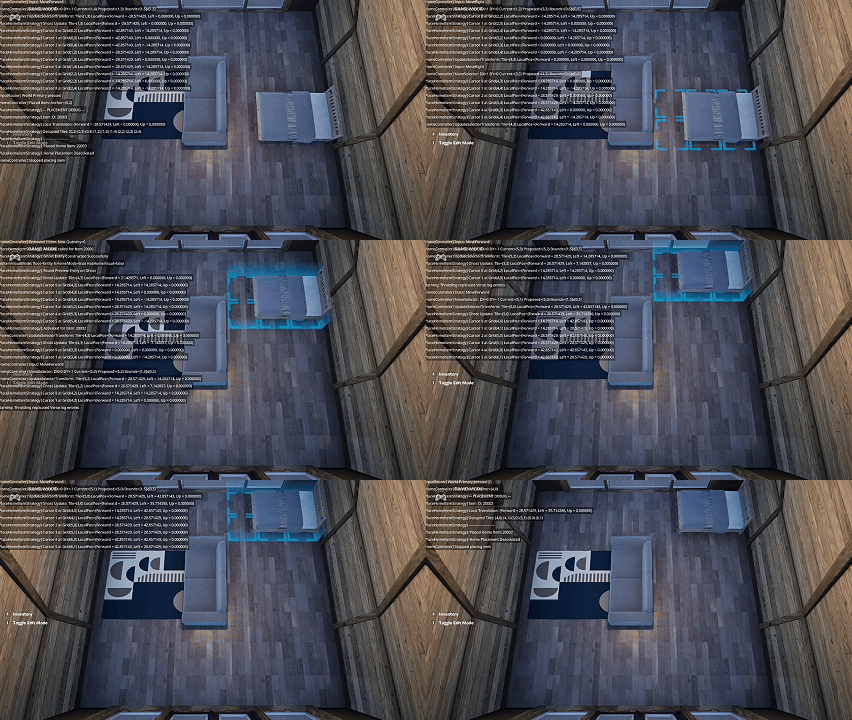
With these fixes in place:
- Placement logic behaves consistently across all surfaces
- Visual indicators correctly reflect placement state
- Edge cases during re‑selection and movement are resolved
Persistence Pass
I completed a full persistence pass for home items:
- Items placed on the floor, walls, and ceiling now save correctly
- All items load back into the correct position and orientation
- Re‑selecting items after re‑entering the home works as expected
This was a critical milestone, since Home_Edit would not be viable without reliable save/load behavior.
Re‑Selection & Editing
Placed items are now fully editable:
- You can re‑select any placed object
- Move it to a new location
- Rotate it again
This applies uniformly across floor‑, wall‑, and ceiling‑mounted items.
Documentation & Agent Updates
To prevent future regressions, I:
- Updated internal documentation
- Revised instructions and context for the coding agents
- Clarified ownership boundaries and expected behaviors
This should reduce friction as more features are layered on top of Home_Edit.
Summary
What I accomplished:
- Completed home item placement for floor, wall, and ceiling surfaces.
- Fixed remaining bugs related to wall and ceiling placement.
- Finalized persistence for all placed home items.
- Enabled full re‑selection, movement, and rotation after placement.
- Updated documentation and agent guidance.
What I learned:
- Persistence is the true test of system completeness.
- Wall and ceiling interactions require extra architectural care.
- Clear documentation is essential once systems reach this level of complexity.